Book your stay
Scroll to navigate
2027 bookings are open !
 Locations mobile homes PMR in Corsica
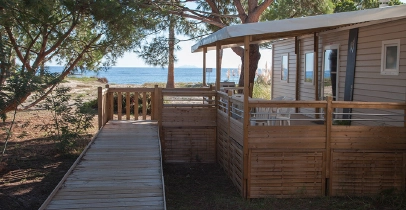
Enjoy a breathtaking sunrise with these RIVAGE PMR mobile homes directly located on our Corsica campsite by the sea. Equipped with two bedrooms, one of which has a double bed, you will be placed directly in the front row on the beach. You will find a fully equipped kitchen attached to your outdoor terrace to enjoy the summer. The bathroom is huge and equipped for people with reduced mobility.
Come and spend an excellent holiday in Corsica in a 4-star campsite with complete peace of mind.
And for your holidays to be extraordinary, take advantage of all our entertainment.
Our PMR range

Our Mobils Rivage can accommodate up to 4 people in our campsite by the sea in Corsica.



x 4
Starting at 364€
See +Rates and Availabilities
FAQ : Everything you need to know about accessible accommodationsOpting for an accessible campsite means securing a rediscovered freedom. Managers have come to understand that welcoming people with reduced mobility required far more than simple cosmetic adjustments. Today, these holiday venues are specially designed to remove everyday obstacles, facilitating the movement of the guests in question. Furthermore, their autonomy is ensured throughout their stay.
The major advantage lies in the global integration of disability. From the car park to the terrace of your rental, everything is designed to minimise effort. It is the assurance of a stay during which, for people with reduced mobility, logistical complexity is removed.
They can thus devote themselves entirely to the peace and pleasure of the outdoors, in the company of their loved ones, in a safe and high-quality setting. This is the very essence of modern hospitality.
The traditional mobile home has had to evolve profoundly to meet accessibility standards. Every accessible mobile home is a masterpiece of ergonomics. To adapt these structures, manufacturers have completely revised the interior layouts. The absolute priority is to guarantee the space required for the full rotation of a wheelchair in all living areas, from the bedroom to the lounge.
For such a holiday accommodation to be validated, it systematically incorporates an external access ramp with a gentle gradient, very wide sliding interior doors, and a bathroom with a walk-in shower fitted with a medical seat. The aim is to create a spacious interior to ensure smooth circulation without any obstructive thresholds. In addition, the furniture (table, worktop, light switches) is lowered for autonomous use.
Among this vast offering, a selection of campsites stands out by offering truly premium services. These cutting-edge establishments are fully adapted and committed to offering a seaside or rural experience without any compromise. The era when the choice of destination was drastically limited to a handful of addresses is over; France today is a universal host country for all travellers.
An accessible campsite does not limit its efforts to the door of your accommodation alone. Accessibility must be considered globally across the entire site. The main paths are tarmacked or stabilised, ensuring easy movement for all campers, whether they use a wheelchair, crutches or a pushchair.
Reception, the shop, the bar and the restaurant are systematically on ground level or equipped with standard ramps. These structural adaptations are absolutely crucial for people with reduced mobility. In a quality establishment, the reception counters are lowered, and shared sanitary facilities specifically adapted for wheelchair users are strategically distributed around the site. It is this ensemble of small details that creates a reassuring, smooth and truly welcoming atmosphere.
Leisure is the beating heart of outdoor hospitality, and must therefore be accessible to all. A 4-star or 5-star campsite deploys enormous resources to make its aquatic complex open to everyone. Gone are the days when swimming was an insurmountable challenge: hydraulic or manual pool entry chairs at the main pools are now commonplace.
Having access to an indoor pool or, preferably, a heated indoor pool is a considerable advantage and an extremely welcome comfort, particularly during the low season or for relaxation moments dedicated to balneotherapy. These spaces are equipped with wide foot baths and changing rooms with grab bars, enabling travellers with reduced mobility to share the joys of swimming with their family in complete independence.
Mobile home rental for profiles requiring specific adaptations demands very significant advance planning. Accessible mobile homes and adapted chalet-type models are very popular and often fully booked months in advance, especially during the peak summer season. To guarantee a space perfectly adapted to your needs, it is strongly advised to book as soon as annual calendars open.
When booking, do not hesitate to call reception to describe your requirements in as much detail as possible. Specify whether you need accommodation close to the central facilities to limit long distances, or whether you need extra space for heavy medical equipment. A good establishment will be able to respond to needs with precision and humanity.
The national Tourisme et Handicap label is the supreme distinction in this field. It aims to identify with certainty the campsites with accessibility for people with reduced mobility that have undergone a rigorous and independent audit by experts. This official label is the absolute guarantee that the site is accessible to people with reduced mobility (as well as other forms of disability: visual, hearing, mental).
Looking for this logo when choosing your stay is a reassuring reflex. It certifies that the accommodations and external infrastructures have been validated. Establishments holding this brand commit to keeping their adapted facilities in perfect condition and to regularly training their staff to respond to the needs of guests in a consistently professional and caring manner.
The very essence of this form of holiday is intergenerational sharing. A campsite for everyone must be a wonderful family campsite, where different generations and physical conditions coexist in joy and ease. Successful family holidays depend on the harmony and comfort of everyone, which makes adapted accommodations absolutely indispensable to the equation.
When grandparents with motor difficulties or a family member in a wheelchair can move around without constantly asking for help, the entire dynamic of the stay is lightened. Adapted mobile homes are the reassuring foundation on which magnificent summer memories are built, proving that physical disability must never again be a barrier to collective getaways.
The major players in the sector have fully grasped the significance of this major social challenge. This is why all our campsites and affiliated partners are drastically evolving their rental stock. The observation is simple: the number of travellers with reduced mobility in France is growing, and the demand for very high-quality holidays follows exactly this same curve.
Thus, some of our campsites now integrate several adapted units into each new landscaped area developed.
These mobile homes are no longer relegated to isolated corners of the site; they very often occupy privileged positions close to the amenities. The managers of a modern campsite know that circulation space is the primary luxury. Investing in structures where one can move freely is the fundamental basis for satisfying an increasingly demanding and legitimate clientele in their expectations.
Before definitively confirming your holiday destination, a thorough check is essential. Never be satisfied with a simple "accessible" mention in a paper brochure. If you are targeting a 3-star campsite or a 4-star campsite, request precise photographs of the ramp and the bathroom of your future rental. People with disabilities have specific needs that vary greatly from one individual to another.
Ensure that the site is genuinely designed to welcome people with reduced mobility in its entirety (is the beach accessible nearby? are the pavements dropped?). Also check that the route to the evening entertainment is genuinely adapted for people with reduced mobility.
While the law imposes strict standards, not all campsites progress at the same pace, hence the paramount importance of choosing recognised and ideally certified establishments.
1. Plan ahead: book your accommodation very early, as the stock of adapted models is limited at accessible campsites.
2. Check: look for official labels (Tourisme & Handicap) for a genuine accessibility guarantee.
3. Space and circulation: current models offer large interior volumes without door thresholds for smooth circulation.
4. Equipment: the bathroom with a walk-in shower and seat is the essential standard for accessible mobile homes.
5. Facilities: ensure the accessibility of pools and restaurants for total autonomy during your stay.
Generally, no. In recent years, the vast majority of establishments have aligned the rates of their accessible accommodations with those of standard mobile homes of the same capacity (often 4 or 6 people). Inclusivity implies fair pricing, with no additional cost linked to disability.
Absolutely. French legislation is strict and protects travellers: guide dogs for the blind and assistance dogs (including for people with reduced mobility) are accepted free of charge in all campsites and their accommodations, even if the establishment normally refuses the presence of pets.
Yes, to ensure these specific accommodations benefit those who genuinely and imperatively need them, campsites generally request a copy of the disability card, the mobility inclusion card (CMI) or a medical certificate at the final confirmation of the booking.
No, not if the establishment is certified "Tourisme et Handicap" for motor disability. These places are designed to offer the greatest possible autonomy (ramps, wide doors, wheelchair-adapted kitchens), allowing a wheelchair user to stay in complete autonomy if their medical condition permits.
Not necessarily. While the internal infrastructure of the campsite may be, direct access to the sea depends on the natural topography. However, many seaside campsites provide sand access mats and lend beach wheelchairs of the "Tiralo" or "Hippocampe" type at reception.
The bedrooms of adapted mobile homes have raised single or double beds to facilitate transfers from a wheelchair, but they are generally not medically adapted (electric beds). If you need a specific bed or a patient hoist, it is often possible to contact a local partner pharmacy to rent one and have it delivered directly to your rental.


 © CAMPING CORSE MERENDELLA | 1976 / 2026 | Seo | Opale Corse | Campsites promotions | SiteMap